Become a Mentor

Become a mentor and mean something to somebody who needs you!

Wednesday, July 14, 2010

Mentors Meeting July 14, 2010

Mentors Session Agenda, July 14, 2010, 5:00 p.m.

  1. Welcome Back to Sydney Levine
  2. Curricular Issues:
    Structure of curriculum: key concepts that each mentor can work on with their students. The kids and mentors can talk about how they are progressing with the concepts and maybe ask questions about things they're having trouble understanding.

    Ideas from the book to use.

    Workgroup to develop curricular framework.

    Book choices.  The book talks about having kids choose the books that are interesting to them. Field trips to the library might help. Helping them get familiar with the online catalog and how to place a book on hold and have it sent to a library that's convenient for them will help as well. This way they can have their choice of every book in the library system rather than relying on just the books at their local library.

    
      13-14 year old girls:
      
      13-14 year old girls, tearjerkers:

Eragon.
Noughts and Crosses
Life of Pi
Once
Then
Troy
Animal Farm
Lord of the Flies
War Horse
Fahrenheit 451
Little Soldier
A Boy called it
Brave New World
Frankenstein
Of Mice and Men
Boy in the Striped Pyjamas (and film)
Goodnight Mr Tom
39 Steps
Diary of Anne Frank
Kiss Kiss
Ten Days to zero.  


  1. Summer Projects: We will distribute a Kodak disposable camera to mentors and to participants (24) next week.  This week they will be jointly write their ideas and plans for its use…the theme might be Beginnings and Endings.  This being the beginning of their showing others what is of interest to them.  The end being the final book we will publish of their pictures, etc.
    AND academically beginnings and endings of words should be integrated into their lessons (I’ve blogged and written the onsets and endings of words, so everyone can find them.)
    They can take any sort of pictures and will journal about them, together or separately, whatever they decide between themselves.
    July 14:  Begin planning, journalling about Beginnings and Endings (in whatever way seems to fit)
    July 21: Get camera, set plan.  Journal
    July 28 or August 4: Return camera (unless they want to wait one more week). Journal about what was taken, how it went, etc.
    August 4 and August 11: Film will have been developed and returned.  Journal about how the pix turned out, what they are about, etc.  Plan book…do they want one big book, separate parts for each person which they can also have?
    August 11 and August 18:  Journalling to continue about pix, about book.  Book will be compiled.
    August 25:  Book will be returned to them…can we do some reading aloud, etc.  Plans for this?
  1. Formation of workgroups:  we might consider forming workgroups so that issues related to the curriculum, meetings with mentors, and supervision of projects and mentors can be shared duties.

More on Books

All the News That Doesn't Fit  
View profile  
 More options Oct 22 2007, 6:36 pm
Via NY Transfer News Collective  *  All the News that Doesn't Fit
Womens eNews - Oct 22, 2007
http://www.womensenews.org
Teens' Favorite Authors Face Book Bans
By Andrea Bronson
WeNews correspondent
NEW YORK (WOMENSENEWS)--Author Carolyn Mackler will meet her fans Oct.
23 in an online chat forum that connects young-adult book authors with
their teen readers. Mackler is just one of the writers featured during
October's "31 Flavorite Authors for Teens" event, sponsored by the
Young Adult Library Services Association and the ReaderGirlz Web site.
Mackler got this chance to talk directly to her readers after 3,495
friends on MySpace picked her as a favorite. However, Mackler's
popularity among young adults has also put her in the spotlight for
negative criticism and even censorship.
Of the 31 authors in this month's online event, 10 have had their books
banned and two have had their books challenged in censorship attempts.
When Mackler received an invitation from the Chicago-based American
Library Association to participate in a "read out" event during Banned
Books Week, Sept. 29 through Oct. 6, she was nonetheless surprised to
learn that she placed fourth on their 2006 list of most challenged
books, released last April.
One of her novels set off a censorship scuffle in a school district in
Carroll County, Md. "The Earth, My Butt and Other Big, Round Things,"
features a central character who is a larger-than-average 15-year-old
girl from a family of perfectionists. In January 2006, 350 students
there signed a petition to put the book back in their schools. They won
and enjoyed a notable triumph for anti-censorship.
However, schools and libraries in many other parts of the United States
have silently removed the best-selling, award-winning novel from their
shelves.
The American Library Association's Office for Intellectual Freedom is
responsible for developing, recommending and maintaining an
anti-censorship program. Deborah Caldwell-Stone, deputy director, says
that locations where challenges occur must be kept confidential to
protect the librarians and others who report them from losing their
jobs or being ostracized from their communities.
Across the nation, libraries and schools are facing budget pressures
and at least 15 municipalities have privatized or outsourced their
public libraries, raising fears among some local library advocates that
they will lose influence in deciding which books are offered to the
public when book selection decisions are left in the hands of private
companies.
Censored as Unsuitable
Those who criticize the novel claim it is unsuitable for this target
age group because of its "sexual content, anti-family, offensive
language," the American Library Association reports.
"The book is about self-esteem, feeling good about yourself as you
are," says Mackler. "I write about normal teenage girls who have many
facets to their personalities and lives. I really try to reflect the
teenage world as it is. I don't gloss over things; I don't ignore the
ugly stuff."
Four other books on the 2006 most challenged list, released last April,
were also censored for female sexual content: Cecily Von Ziegesar's
"Gossip Girl" series, Phyllis Reynolds Naylor's "Alice" series, and
"The Bluest Eye" and "Beloved," by Nobel Prize-winner Toni Morrison.
The book market for female teens is booming, says Paula Brehm-Heeger,
president of the 50-year-old Young Adult Library Services Association,
the fastest growing division of the American Library Association.
"There's an explosion of publishing for teens now, especially books for
teenage girls because it's a market that really responds."
But as the number of published books for female teens has risen so has
the number of bans targeting those that delve into young women's
lifestyles and sexuality. Although there is no official tally for how
many teen books have been censored, out of 3,019 reported challenges
between 2000 and 2005 to the Office for Intellectual Freedom, 1,824
were initiated by parents and 2,289 of the institutions dealing with
demands for censorship were schools or school libraries.
Challenges Unreported
For every challenge reported, four or five remain unreported, says
Judith Krug, director of the Office for Intellectual Freedom.
A challenge is an attempt to censor books, while a ban is the actual
removal of the book from a school or library. In the United States, a
complaint from a single parent can sometimes restrict an entire school
district's access to a book, says Mackler.
"We want to encourage students to speak out," says Judy Blume, who has
seen most of her books--from those penned for teens such as "Forever"
to books for children such as "Tales From a Fourth Grade
Nothing"--challenged.
Blume, a friend and mentor to Mackler, is the second-most challenged
author from 1990 to 2004, according to the American Library
Association, after Alvin Schwartz, a children's horror writer whose
books have been challenged for cannibalism, murder and occult subjects.
Blume wonders at Mackler's ranking. "To me, Carolyn's book has nothing
in it that could possibly offend anyone."
Phyllis Reynolds Naylor, author of the third most challenged book of
2006, remembers when a group of "grinning, 12-year-old boys" came to a
bookstore to buy "Alice" books.
"'You must really like these,' I said as I signed my name, and one guy
leaned over and whispered, 'We learn about girls this way,'" Naylor
recounts.
The majority of fans of Naylor, Blume and Mackler, however, are female
teens and "tweens," ranging between the ages of 10 and 17.
Teen Reads, a Web site founded in 1997 to encourage teens to develop a
lifelong love for reading, features the "Ultimate Teen Reading List,"
250 books selected by teens for teens. Carol Fitzgerald, president and
founder, says the site is predominantly for girls because they read
more fiction, while boys read more nonfiction.
Censorship Magnets
Fitzgerald suggests that female teens' books attract more censors
because more exist and they contain more sexual content.
Naylor believes that gender-based sexual expectations play a role. "As
long as girls are taught to say no, I suppose it's assumed that male
sexuality can be reined in. But if girls are described as getting the
'hots,' why goodness gracious, who knows what will happen?"
Blume, Naylor and Mackler--the latter two participated in the Chicago
"Read Out" during Banned Books Week--say they seek to portray teen life
and sexuality realistically.
"As people who really advocate for teenage girls, we want them to be
empowered in all ways," says Mackler. "To not read about sexuality and
to not have any information on it will not make a teenager not have
sex; it will make them go into sexual situations uninformed."
Naylor laughs at how little she learned about such issues from books
she read as a child. "Are you kidding? Did Nancy Drew even have
breasts?"
Blume says masturbation is particularly taboo, remembering a caller on
a radio show who told her that she was teaching children masturbation
was healthy while they were teaching it was a sin.
"There is so much fear that if your child reads this, your child will
know it, then your child might do it, or it might happen. Where else in
the world are we so afraid of puberty?"
Authors should write the best book possible, without fear of
censorship, Blume argues, because censors can challenge any subject.
But Blume's younger counterpart feels the censor over her shoulder. "I
get publicity from censorship," Mackler says, "but how many places will
my book not be read or purchased or looked at? I write books to be
read."
[Andrea Bronson is a freelance journalist based in New York City.]
For more information:
American Library Association Banned Books Week: -
http://www.ala.org/ala/oif/bannedbooksweek/bannedbooksweek.htm
Teen Reads: - http://www.teenreads.com
Reader Girlz: - http://www.readergirlz.com
Copyright 2007 Women's eNews. 
I don't know what age these are good for, but I found it on the internet:

A while ago a friend of mine asked me for the names of some of the authors I read. This got me thinking and I figured I'd make a list of a few of my favorites. So, in no particular order...

"Neuromancer" by William GibsonWilliam Gibson: I've read Neuromancer so many times the book has nearly fallen apart. I like how he describes things enough to get a vivid image in your head but not with such numbing detail you get bogged down. Plus, how can you deny the guy who coined the term "cyberspace?" I've read all of his books and I have yet to find one I didn't like.
Richard K. Morgan: Morgan has created a future world where your personality lives in a "cortical stack" at the base of your skull and a character named Takeshi Kovacs is an ex special-forces soldier turned investigator for hire. Action packed and a really fun read, Altered Carbon is the first book in that series.
Tom Clancy: Clancy's sort of hit-or-miss. I've read some of his books that just take freaking forever to get where they're going, but others are really exciting. Most of the books revolve around a modern-day wartime environment. I particularly liked Rainbow Six.
Jeff Noon: Noon writes in a very distinctive style that seems to resonate for some folks but not as much for others. If it works for you, it really works, and the books are amazing. His primary series revolves around a world where we exchange objects between our world and a parallel world and what comes back is a powerful hallucinogenic drug... that you take by sticking a feather in your mouth. If you think it sounds weird, you're right, it is... but it's a very compelling universe, too. The first book in the series, Vurt, brings with it the added challenge that it's written in an invented dialect so it may take a bit to get into, but give it a shot. when I was done with it, I immediately flipped back to the first page and read it again.
"Vurt" by Jeff NoonSteve Aylett: I'll admit I've only read one of Aylett's books - Slaughtermatic - but it was so good I have to include him here. In this particular book, the world is a place where crime is a form of recreation and time travel is possible. It's admittedly a little convoluted, but a really fantastic read.
Philip Pullman: Specifically, Pullman's "His Dark Materials" trilogy which starts with The Golden Compass (also made into a movie). In this world, your soul is physically embodied as a "daemon" - an animal that travels with you. When the movie came out a lot of stink got raised about the social commentary on organized religion that these books present, but I really feel like that was a lot of crap. Is there some commentary? Sure. Is it as important or prevalent as the folks out there would like you to think? I don't think so. This is another set of books I've read several times and enjoy every time.
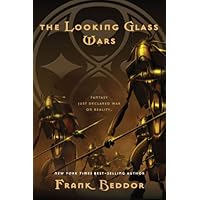
"The Looking Glass Wars" by Frank BeddorFrank Beddor: I am an Alice in Wonderland freak. I love the story, the characters, and I love imaginative derivatives of it. Beddor has created my favorite reimagining with his "Looking Glass Wars" trilogy - the idea being that Wonderland is a real place and Alyss Heart is a real person who ends up crossing into our world and getting trapped. Not difficult reads but some of my favorites. There's even a soundtrack that goes along with them.
Neal Stephenson: Again, sort of hit-or-miss for me, but I can't recommend more strongly that everyone read Snow Crash. Where else would you find a place where pizza delivery is controled by the mob and it arrives at your house via a guy you refer to as "The Deliverator?" Cyberpunk action at its finest.
Neil Gaiman: Is there a "favorite authors" list Gaiman isn't on? Every story is different and imaginative in its own right, but my absolute, all-time favorite, and one that I have yet to find anyone disappointed with, is his collaboration with Terry Pratchett:Good Omens. Of course, if you were offended by the "commentary" in Philip Pullman's "His Dark Materials" series, Good Omensis probably not for you... but otherwise it's a must-read.
Douglas Adams: The Hitchhiker's Guide series are some favorites for me (and a ton of other people) and I've loved them since I was a kid. One of the best birthday gifts I've gotten was a leather-bound copy of the first four books in the series. I've read them, listened to the audio books (on tape!), seen the movies/TV shows... I can't get enough. Truly funny stuff.
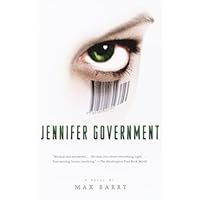
"Jennifer Government" by Max BarryMax Barry: You also might see him listed as "Maxx Barry" but he seems to have changed that in recent times. I discovered Barry through his book Jennifer Government: Welcome to a place where enterprise has taken over enough that your last name is the name of the company where you work and a shoe manufacturer tries to earn "street cred" for his shoes by killing people who buy them. His subsequent efforts are no less interesting or imaginative. Barry's another one where I've read all of his books and love them all.

If you're looking for something new to read, maybe check some of these out. If you do, drop me a line and let me know what you think.

Favorite Teen Age Angst Books

Kids commenting on books they like are at this site.

They all like this one:S.E. Hinton The Outsiders

Here's another review of Darkness:
I read Darkness, Tell Us by Richard Laymon. Keith, Angela, Lana, Doris, Howard, and Glen, college kids, at a party decided to fool aroung with an Ouija board. It was just a game, right. However, they started getting messages from a spirit named Butler. After Butler told them about a hidden treasure, they decided to go after it. However, what they found wasn't what they expected. I really enjoyed reading this book because it was extremely excited. I never new what was going to happen next. In addition, once I started reading it, I couldn't stop. Richard Laymon did a great job of creating suspense throughout the novel. I would recommend this book to teenagers and adults as well as both males and females. However, I would not recommend this book to anybody who dislikes supernatural novels because there are several creepy sections of it. All in all, I feel that Darkness, Tell Us is an extremely exciting and excellent book.


Hi, I haven't read many good books but I am interested in reading more. I liked Catcher in the Rye and I'm going to read The Perks of Being a Wallflower. Can you give me any suggestions or do you know of any other books like these??? Thanx


Here are some favorite authors on this site.

The Literacy Project from Google

A resource for teachers, literacy organizations and anyone interested in reading and education, created in collaboration with LitCam, Google, and UNESCO’s Institute for Lifelong Learning.
The Literacy Project.
In honor of World Book Day, check out some innovative projects from our partners.
Find books, articles and videos about literacy, or start your own literacy or reading group!

Thursday, July 8, 2010

Henry Jenkins on Transmedia Education for Teachers

Transmedia Education: the 7 Principles Revisited

|  | Comments (2)
Last week, I participated in one of the ongoing series of webinars for teachers which is being conducted by our Project New Media Literacies team. The series emerges from an Early Adopters Network we are developing with educators in New Hampshire to drill down on the skills we identified in our white paper for the MacArthur Foundation and to think through how teachers in all school subjects and at all levels can draw on them to change how they support the learning of their students. Vanessa Vartabedian is the coordinator who has been running this series. Each month, they focus on a different skill. This month's focus was on Transmedia Navigation. The webinars are open to any and all participants and are drawing educators from all over the world. The webinars are also available after the fact via podcast. The Transmedia Navigation discussion involved not only some remarks by me but als o a conversation with Clement Chau from Tufts University and Mark Warshaw from the Alchemists who has developed transmedia content for Smallville, Heroes, and Melrose Place, among other properties.

"Our Ning site is where our community of educators are exchanging ideas and trying out resources. You simply need to sign-up and fill out a short profile to access the schedule of upcoming webinars, as well as links to the archived recordings for previous webinars." 

The focus of transmedia navigation offered me a chance to think a bit more deeply about what it might mean for us to produce transmedia education and I thought I would share some of those insights with you.

Sunday, July 4, 2010

Sydney Returns

Hi everyone,

I'm back after two months abroad.  It was great getting a new rhythm, new places, new projects.  I hope my fresh eyes will be happily seeing you all soon...like next session.

Now for assessment, moving on, joining forces, keeping this going... I hope everyone has enjoyed their experience and wants to continue.  Everyone is doing such great jobs, and I know we are all sort of whistling in the dark, getting to know how to operate this new machinery, how to get to children, to relate and move the relationship on toward reading...

Reading what is most interesting is how to get to reading.

It took me a lot of motivation, to learn what that picture of The Girl in the Chicken Coop was doing in that wild ocean.  Who was she and what was happening to her awoke me to the world of reading and storytelling and it was thanks to L. Frank Baum and the Oz books that I got going.

Who has read Narnia?  Would Gabriella like Narnia?  First read it and then see the movie, not the opposite way around, because then they can compare the movie to what they had imagined it to be in their head when they read the book.  That's a good summer read and then to cap it with the movie would be great.  Doesn't matter who reads to whom, it's good to start something new and different.

We should all see the film Chain Camera.  Let's get those cheap little Kodaks for everyone to use and then to share...and perhaps to write about later...Mentors and Mentees will both benefit from that summer exercise.

And LALIFF is coming up!  We get to go on the Red Carpet, and we get to be a part of the film literacy project.

And other tutorial, mentorial, educational groups are approaching us, perhaps there are other ways to grow this project...we take care of a particular age group - those who the school system is about to forget about, those who might drop out as a result of neglect and go on to prison instead of to college.

In Carcera o In College?  Which will it be?  Now is the time these young folks make their decisions, now is the time for us to be there. Incarcerated or incollegeiated? En carcera o en collegio?  Let's opt for the latter!

Happy 4th of July!  Here's to Freedom and Independence!

See you soon!